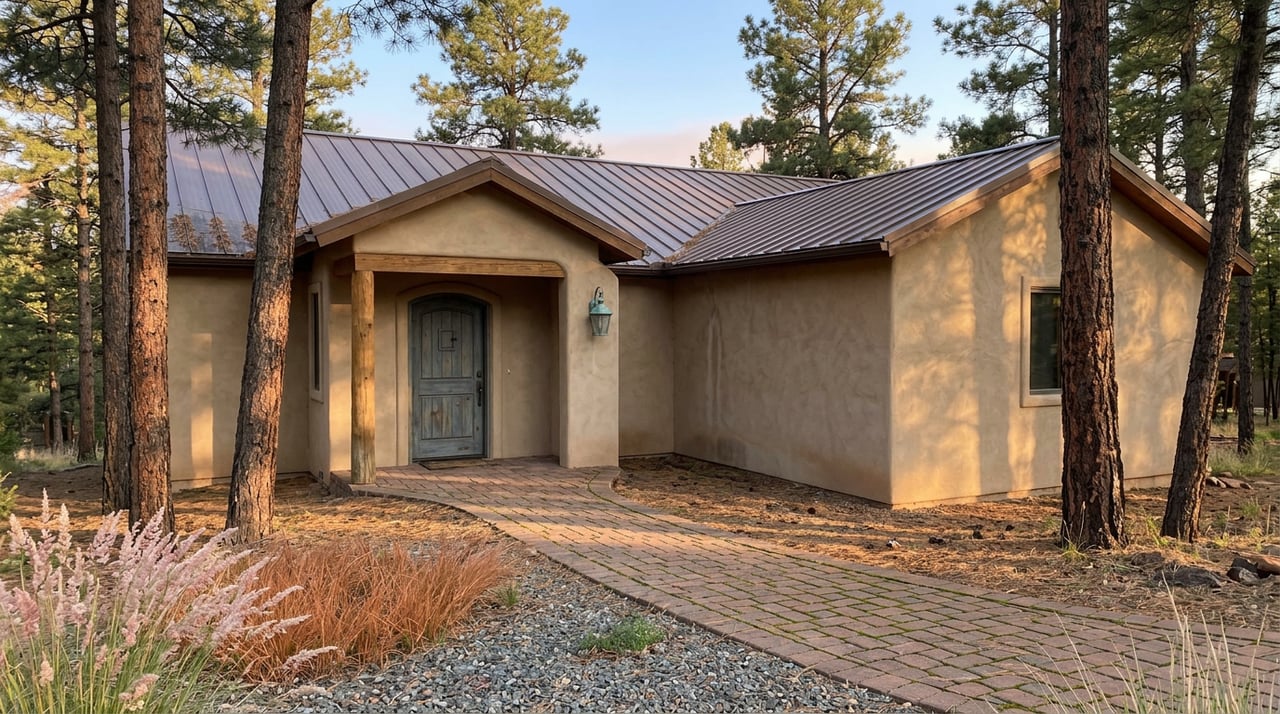
Why would two homes ten minutes apart in Alto handle water and wastewater in completely different ways, one with a metered utility bill and treated water on demand, the other with a well permit, a septic tank, and a contractor's invoice that can run into five figures?
Because Alto isn't one utility zone. It's two, and the line between them doesn't show up on a listing sheet, a drone photo, or most buyer tours. It shows up in a New Mexico Environment Department permit database and a quasi-municipal district's service map, and it's usually the last thing anyone checks, right around the time an offer is already written.
The boundary nobody points out on a tour
Buyers coming up from Albuquerque have a reasonable assumption baked in: turn on the tap, water shows up, flush the toilet, it goes somewhere the city handles. That assumption holds inside Albuquerque city limits. It does not automatically hold once you cross into Lincoln County, and it especially does not hold uniformly across Alto, where some subdivisions sit inside a formal water and wastewater utility and others sit outside it entirely, dependent on whatever well and septic system came with the lot or needs to be built from scratch.
The utility inside Alto is real, chartered, and older than most of the homes it serves. The Alto Lakes Water and Sanitation District is a quasi-municipal governmental subdivision of the state, created after property owners voted on the idea in 2004 and a Lincoln County Special Districts Commission hearing that August found the formation was in the community's interest. An election that January put a five-member board in place, and a district court judge formally ordered the district into existence on January 19, 2005. Three years later, on April 1, 2008, the district completed an asset purchase from the private Alto Lakes Water Corporation, using roughly $2.5 million of $4 million it had lined up through the New Mexico Finance Authority, and took over the water, wastewater, and solid waste systems serving the community.
That's not a homeowners association collecting dues for a clubhouse. That's a public utility with bonding authority, a board, and capital projects, the same basic structure Albuquerque buyers already understand, just smaller and locally governed.
What the utility side actually looks like
Since taking over the system, the district has run it the way any regulated water utility does. It built a Phase I water treatment plant, completed in April 2011, specifically to address iron and manganese in the source water. It funds distribution-line rebuilds through low-interest state loan programs rather than special assessments on individual owners. As of a 2026 water quality summary, it serves roughly 2,870 residents, and its water has shown no recent EPA health violations on record.
If your Alto lot sits inside this district's service area, buying the home means inheriting a metered water bill, a wastewater connection, and a leak credit policy on file with an actual board, not a private negotiation with a driller. It also means you skip an entire category of due diligence that trips up buyers on the other side of the line.
The other side of the line: an exam, a stopwatch, and a real dollar figure
Step outside the district's footprint, whether that's a different pocket of Alto or acreage further out toward Capitan, Nogal, or the Hondo Valley, and the water and wastewater question becomes a private, permitted, individually-financed project.
On the water side, every well in New Mexico requires a permit from the Office of the State Engineer before drilling starts, and domestic wells are capped at three acre-feet of use per year under the state's prior appropriation system. Permit fees themselves are modest, typically $150 to $500, but the complete system, drilling, casing, pump, pressure tank, electrical work, and testing, is where the real cost lives. Statewide cost trackers put a complete residential well system in New Mexico anywhere from roughly $12,000 on the low end to well over $40,000 depending on depth and geology, with Albuquerque-area wells running deeper and costing more because the water table sits farther down. There's also a scheduling wrinkle worth knowing before you count on a well as a contingency fix: drilling in mountain terrain is generally limited to May through October, since snow and access problems shut rigs down the rest of the year.
On the wastewater side, New Mexico regulates septic systems through the Environment Department's Onsite Wastewater Bureau, and Lincoln County properties fall under that statewide program directly. That's actually a useful point of comparison for Albuquerque buyers specifically. Bernalillo County is the only county in the state with its own separate wastewater ordinance, so a buyer who has only ever dealt with Albuquerque-area permitting is used to a process that doesn't exist the same way anywhere else, including Alto. Everywhere in Lincoln County, a septic system permit runs through NMED's standard process: a licensed installer pulls the permit, or a homeowner can qualify to install a simple conventional system after passing a written exam and paying $395 in combined fees, $170 for the homeowner qualification and $225 for the liquid waste permit itself on a system rated at 1,000 gallons per day or less. NMED's own posted timeline gives conventional systems up to five business days for a completeness check and ten business days for a decision, while advanced treatment systems take longer, up to ten days for completeness and twenty for a decision.
Here's the comparison in one place:
| Inside Alto Lakes Water & Sanitation District | Outside the district (Alto acreage, Capitan, Nogal, Hondo Valley) | |
|---|---|---|
| Water source | Treated, metered utility connection | Individually permitted private well, OSE approval required |
| Wastewater | Utility sewer connection | Individually permitted septic system, NMED approval required |
| Governing body | Alto Lakes Water & Sanitation District board | New Mexico Environment Department, statewide program |
| Upfront cost to establish service | Utility hookup fee, ongoing metered bill | Complete well system commonly $12,000-$40,000+; septic system commonly a few thousand to over $12,000 |
| Permitting timeline | Utility connection process | Roughly 1-3 weeks for standard permits, longer for advanced systems or variances |
| Seasonal constraint | None | Well drilling generally limited to May through October in mountain terrain |
The gap between those two columns is not a rounding error. It's a five-figure cost difference and a seasonal deadline that can determine whether a closing happens on schedule or waits for spring.
Why this catches Albuquerque buyers specifically
The buyers most likely to skip this check aren't careless, they're just applying a reasonable rule from where they came from. In Albuquerque, water and sewer infrastructure is uniform enough that nobody thinks to ask which utility serves a specific address. In Alto, that question has a real answer, and it changes by subdivision, sometimes by which side of a road a parcel sits on. A buyer moving up from Albuquerque, RIo Rancho, or another New Mexico city with municipal utilities is the exact profile most likely to assume Alto works the same way everywhere, and the exact profile most likely to be surprised by a well and septic bid landing on their desk after the offer is already accepted.
Questions to ask before you write the offer
- Does the district serving this address show up on the Alto Lakes Water and Sanitation District's customer list, or is the parcel outside its service area?
- If the home already has a well and septic system, is there a permit on file with NMED, and when was it last inspected or pumped?
- If the lot is vacant or the system needs replacing, has a percolation or soil test been done, and what does the site's soil type suggest about drainfield size?
- Is there a seasonal deadline tied to well drilling that affects your closing timeline?
- If you're comparing two lots, are you comparing the sale price alone, or the sale price plus whatever it costs to establish or verify water and wastewater service?
A few direct answers
Does every home in Alto Lakes have utility water, or only some? Only properties within the Alto Lakes Water and Sanitation District's service area are connected to its water and wastewater system. Not every Alto address falls inside that boundary, so it has to be confirmed parcel by parcel.
Can I install my own septic system to save money? New Mexico allows a homeowner to qualify to install a simple conventional system on their own personal residence after passing an NMED exam, but the same permitting fees and inspection requirements apply either way, and the qualification only covers a personal residence, not a rental or investment property.
Is well water in this area safe to drink without treatment? New Mexico doesn't mandate testing for private wells, though the state health department recommends annual testing for bacteria and nitrates at minimum, with broader panels every few years for things like arsenic and fluoride. That testing cost and schedule is worth budgeting for separately from the well itself.
None of this means one side of the line is a better buy than the other. A well and a septic system, properly permitted and maintained, serve plenty of good homes in Lincoln County. What it means is that the utility question deserves the same weight as square footage or lot size when you're comparing two Alto properties, because it changes the real cost of ownership before you've moved a single box.
If you're weighing an Alto property and want to know which side of that line it falls on before you write an offer, Misty Strickland can walk you through what a specific parcel actually has, and what it would take to confirm it.