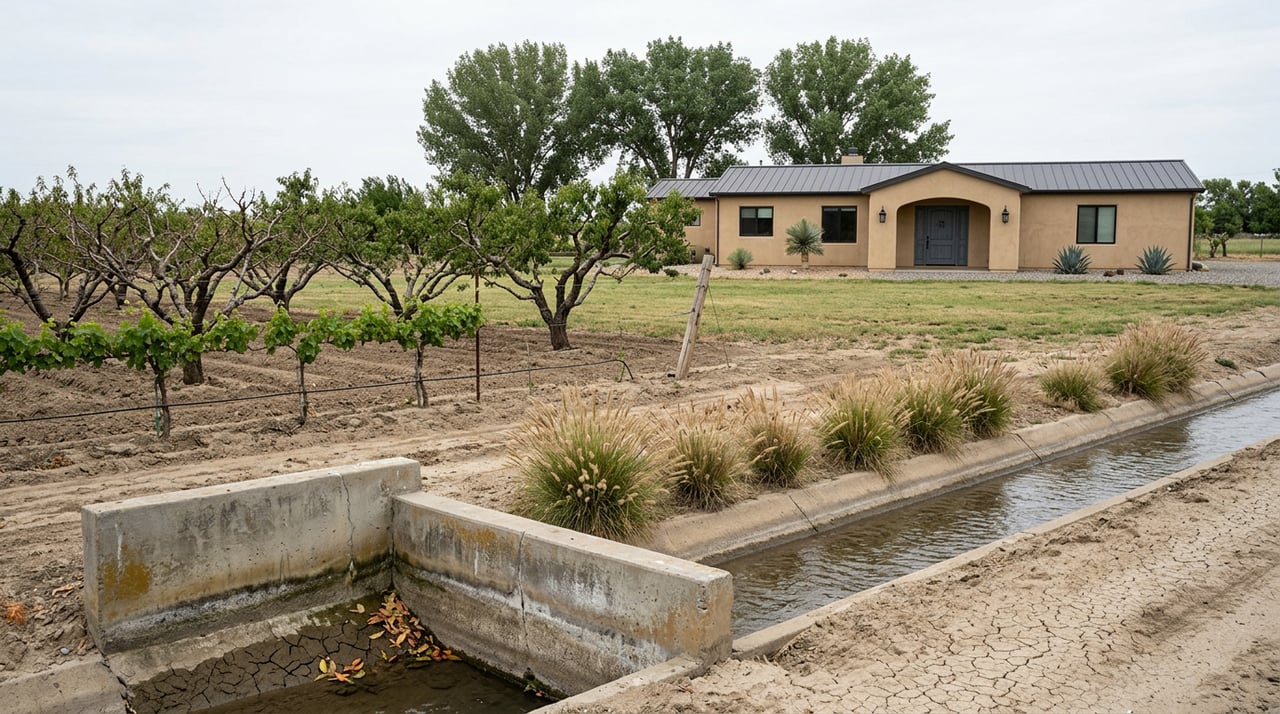
A one-acre parcel in Corrales can sit on the tax rolls for a couple hundred dollars a year, or several thousand, and the difference has almost nothing to do with the house on it, the view, or the ditch frontage a listing agent likes to mention. It comes down to a single legal classification that the county assigns, reviews, and can take away. Sandoval County Assessor Linda Gallegos put it plainly to the Corrales Village Council in 2024: the gap between agricultural and market valuation on identical vacant land can run from "a couple of hundred dollars" to "thousands of dollars" a year, for the same parcel.
That gap is not a quirk. It is the entire point of New Mexico's agricultural special-method valuation, and it is currently under more scrutiny in Corrales than it has been in years. If you are comparing Corrales to other North Valley or metro neighborhoods based on lot size and a listed tax bill, you are looking at a number the county can change, and in some cases is actively rechecking right now.
What the tax break actually is
New Mexico's Greenbelt statute, codified at NMSA 7-36-20, lets qualifying land be taxed on what it can produce rather than what it would sell for on the open market. The idea dates to a national wave of farmland-preservation laws, and New Mexico's version means a parcel used for hay, orchard crops, or grazing can be assessed at a fraction of its market value, regardless of how close it sits to a subdivision or a golf course.
The catch is in the word "qualifying." Sandoval County's own valuation policy is specific: the agricultural use cannot be passive or incidental, and the property owner carries the burden of proving it. A homesite and its surrounding acre are presumed to be residential by default. If you want anything beyond that one acre valued as agricultural, you have to show the county evidence, not just intent.
That evidence bar has real teeth. New Mexico case law has already drawn the line on what does not count. Grazing a couple of horses for pleasure riding does not qualify as agricultural "home consumption" under state regulation, no matter how many acres the horses have to roam. Documented hay production, an active orchard with sales records, or livestock raised for sale can qualify. A well-kept pasture with two trail horses on it, by itself, usually cannot.
The county is actively rechecking accounts
This distinction is not theoretical in Corrales right now. Gallegos and her chief assessment officer, Edward Olona, told the Village Council in August 2024 that the assessor's office was running a full review of agricultural accounts countywide, with a particular concentration in Corrales. Owners who have carried agricultural status for years, sometimes decades, are getting letters asking them to document it again: sales receipts, farm income reported on a federal Schedule F, water usage records, or photographs showing active production.
The policy allows some flexibility. Land can be "rested" for up to three consecutive years without losing agricultural status, which matters in drought years when a field goes fallow. But the underlying requirement doesn't move: the burden of proof sits with the landowner, not the assessor, and a status that was granted in 2005 does not automatically survive a 2026 review.
This isn't old news that has since settled. The question of how aggressively the county should police agricultural exemptions was still live enough to appear in a Sandoval County Assessor candidate questionnaire circulated through the Village of Corrales in May 2026, with the candidate stating a belief that most agricultural properties in the county are legitimately farmed and that oversight should continue without becoming "overly aggressive." Whoever holds that office is making a judgment call on exactly the standard your future tax bill depends on.
What ag valuation and market valuation actually look like side by side
| Agricultural valuation | Market valuation | |
|---|---|---|
| Taxed on | Land's productive capacity | Fair market value |
| Requires | Documented, ongoing production (sales, Schedule F, water records) | Nothing beyond standard ownership |
| Homesite treatment | Presumed 1 acre is residential regardless of surrounding acreage | Entire parcel valued at market rate |
| Risk to buyer | Status can be reviewed, denied, or revoked; rollback taxes possible on a use change | None, but no discount either |
| Owner's burden | Must prove active, non-incidental use | None |
The rollback exposure is the part buyers tend to skip past. If a parcel loses its agricultural status, whether because the new owner stops farming it, subdivides it, or simply can't produce the paperwork the county now wants, the county can assess back taxes to recapture the years of discount. That is a real cost that shows up after closing, not before it.
The other half of the equation: what you're allowed to build
Tax status determines what you pay to hold the land. A separate, live debate in Corrales determines what you are allowed to do with it. The village adopted a new comprehensive plan in 2025, and one of its recommendations is to cut the maximum allowable lot coverage from 35 percent down to 25 percent in certain zones. As of a January 2026 council meeting, the change had not been adopted, and members said they wanted more information before deciding. Under current rules, a home on a one-acre lot can legally cover more than 15,000 square feet with structures, driveways, and other impervious surface. The proposed cap would bring that down to 10,890 square feet.
The council members pushing the reduction weren't talking about tax policy at all. They were talking about preserving what one speaker described as the village's preference for open landscapes and modest building footprints over larger, denser construction. But the effect on a buyer's math is the same kind of quiet variable as the agricultural review: the acreage on the plat doesn't tell you what you can actually build, any more than the current tax bill tells you what you'll pay in five years.
Put the two threads together and a pattern emerges. Corrales has spent decades letting large lots exist because of two separate policy choices, a tax code that rewards keeping land in production and a zoning culture that resists dense building. Both of those choices are being actively re-examined at the same time, by the same community, for related reasons. Neither is settled.
What this means if you're comparing Corrales to somewhere else
If you're weighing a Corrales acreage property against something in Rio Rancho, the North Valley, or a subdivision closer to Albuquerque, the sticker price and even the current tax bill are the least reliable numbers on the listing. The property's status, not its size, is what will determine your actual carrying cost. Before you build that cost into an offer, it's worth asking:
- Has this parcel's agricultural status been reviewed or requestioned by the county assessor in the last two years?
- What documentation currently supports the status, and does it transfer with a change in ownership, or does a new owner have to reapply and prove use from scratch?
- If the status lapsed or was revoked, what would the property's tax bill look like under standard market valuation?
- Is any portion of the parcel under a conservation easement, which carries its own separate valuation and stays with the land regardless of who owns it?
- Does the lot's current buildable footprint reflect the existing 35 percent lot-coverage rule, or should you plan around a tighter standard the village council may adopt?
None of these questions show up on a listing sheet. They show up in the assessor's file and in the minutes of village council meetings, which is exactly why they get missed by buyers moving quickly, and exactly why they're worth a phone call before you write an offer.
Corrales earns its reputation as a place where land still functions like land, where orchards, pastures, and working ditches sit inside sight of the city. That reputation is upheld by policy choices the village is actively revisiting this year. A large lot here is not a fixed asset with a fixed cost. It is a legal status with an expiration date nobody prints on the deed.
If you're comparing acreage in Corrales against anything else on the market, Misty Strickland can walk you through what a specific parcel's agricultural status and zoning history actually mean for your carrying costs, not just its listing price. Call or email for a personal market consult before you factor a tax discount into your offer that may not be yours to keep.