Ask that question online and you will get three confident, contradictory answers, sometimes from the same website. One guide will tell you sellers customarily cover the owner's title policy in New Mexico. Scroll further on that same site and you may find a sentence claiming the opposite, that New Mexico treats owner's title insurance as a buyer-paid expense. A third source will tell you it is simply more common for buyers to pick up the tab here. None of them are lying. They are describing a custom that was never written into law, and most of them never checked what New Mexico's own real estate contracts actually say.
For sellers preparing to list in Albuquerque, this is not academic. New Mexico title fees run about 0.34% of the sale price, per closing-cost data published in early 2026, which on a home near the metro's median sale price of $360,000 over the three months ending June 2026 works out to roughly $1,200. That line lands at the closing table, not the listing appointment. For the sizable slice of Albuquerque sellers who are cashing out equity to buy a second home in Alto or Ruidoso, that $1,200 is real money against a mountain down payment. Getting the assumption wrong costs you leverage you didn't know you had.
The Difference Everyone Skips: A Regulated Rate Is Not a Settled Bill
New Mexico is one of a handful of states, alongside Florida and Texas, where title insurance premiums are promulgated. That means the New Mexico Office of the Superintendent of Insurance sets the actual rate schedule, so two different title companies cannot legally charge different premiums for the same coverage on the same property. This is the part every guide gets right, and it is also the part that misleads people into thinking the whole transaction is standardized.
It is not. The rate is fixed. Who writes the check is not. Those are two separate questions, and almost every generic explainer collapses them into one, which is exactly how you end up with contradictory advice sitting on the same page.
| What's actually regulated | What's actually negotiable |
|---|---|
| The premium amount for owner's and lender's policies | Whether buyer or seller pays the owner's policy premium |
| The title search and examination fee, bundled into the premium | Who orders and pays for a survey or improvement location report |
| New Mexico's lack of a state deed transfer tax | Recording fees, closing fees, and how they're split |
What New Mexico's Own Paperwork Actually Says
This is where it gets interesting, because the New Mexico Association of Realtors writes two different standard contracts, and they don't handle this the same way.
The commercial version of the state's standard purchase agreement is explicit. It states plainly that the seller shall pay the premium for the standard New Mexico form owner's title insurance policy, while the buyer picks up any endorsements or extended coverage added on top. No ambiguity, no blank to fill in.
Residential sales work differently. The same national title underwriters that publish New Mexico's state-by-state customs reference list the owner's policy premium for residential deals as seller pays, can be negotiated, not an unconditional assignment the way the commercial form spells it out. New Mexico's promulgated rate schedule fixes what the policy costs. It says nothing about who writes the check. That decision is left to the purchase agreement itself, negotiated line by line, not printed as a default the way the commercial contract handles it.
That small parenthetical, can be negotiated, is doing a lot of work. It reflects what the industry treats as the starting assumption in most residential deals, while quietly admitting that the starting assumption is exactly where plenty of local negotiations end up moving.
Why the Guides Disagree With Each Other
Here's the part worth sitting with. One widely cited closing-cost calculator states flatly that it's more common for the buyer to pay for owner's title insurance in New Mexico, the reverse of what the national underwriters' custom sheet says. Meanwhile, a different consumer guide manages to contradict itself within the same article, first describing New Mexico as a state where owner's title insurance often falls to the buyer, then a few paragraphs later stating that sellers usually pay it.
That is not a fringe disagreement. That is three different explanations of the same New Mexico transaction landing in three different places, sometimes within a single source. It happens because "custom" gets treated as if it were statute, when it is really just the term everyone defaults to before the contract gets marked up.
The lesson isn't that one guide is right and the others are wrong. It's that whoever is running your closing needs to know this is a negotiated line, not a settled fact, and needs to put the actual number in front of you before you're staring at a closing disclosure wondering why your net sheet looks different than you expected.
The Money at Stake When You're Buying North Into the Mountains
This detail matters most for a specific kind of seller: someone letting go of an Albuquerque home to fund a purchase in Alto or Ruidoso. If you're extracting equity from one sale to make a competitive offer on a mountain property, every negotiable closing cost is a lever, not a footnote. A seller who assumes they're on the hook for the owner's policy premium, when a stronger negotiating position could have shifted it, is quietly shrinking the check that becomes their down payment up in the mountains.
This is precisely the kind of detail that gets missed when a transaction is treated as a form to fill out rather than a document to negotiate line by line, which is the difference a closing background actually makes at the table.
The Bernalillo County Wrinkle That Surprises Sellers
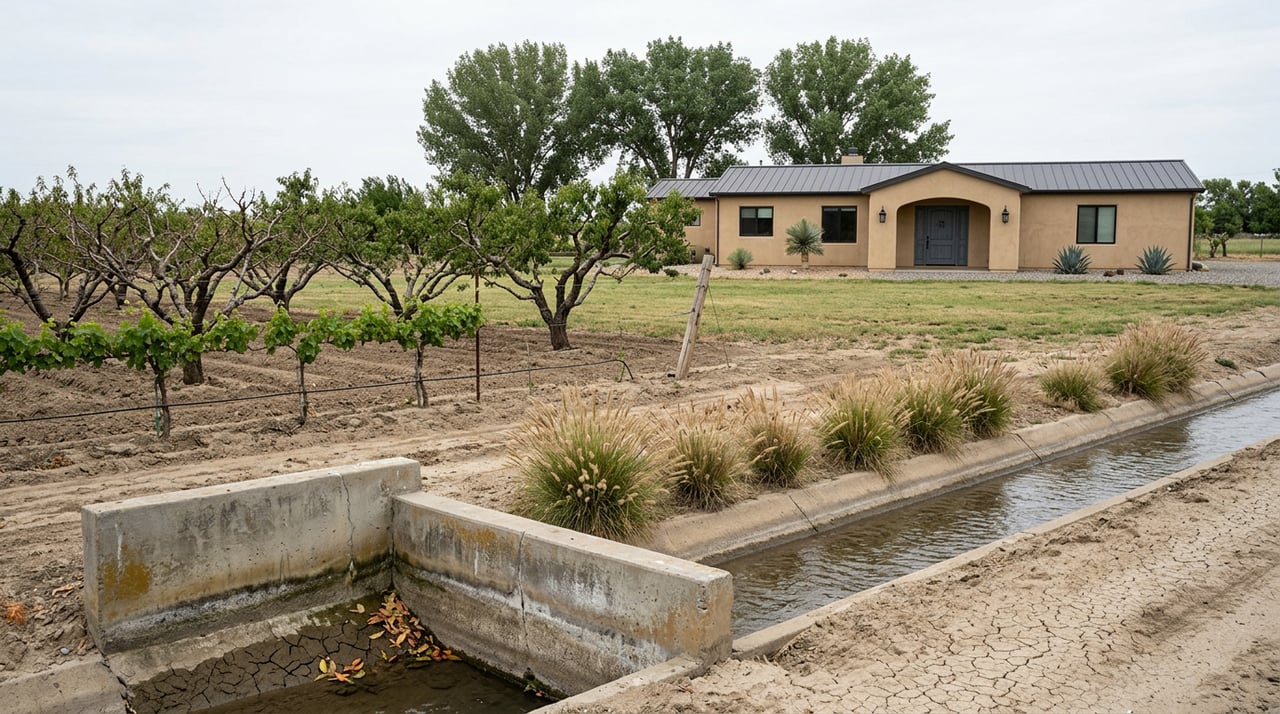
There's a second layer specific to certain Albuquerque properties that a generic title-insurance guide will never mention. Homes in the North Valley, South Valley, and parts of unincorporated Bernalillo County sometimes carry irrigation district assessments or informal historic land divisions that a straightforward suburban closing never has to touch. These items don't usually derail a sale, but they take time to verify and clear, and if your title company or closing attorney doesn't flag them early, they surface late, at the exact moment you have the least room to negotiate anything, including who's paying for what.
If your Albuquerque property sits in one of these older, ditch-adjacent neighborhoods, ask your title company directly whether an irrigation district assessment search is part of your standard commitment, or whether it needs to be requested. It's a five-minute question that can save you a delayed closing.
Get It in Writing Before You List
- Ask your agent to confirm the owner's policy allocation in writing before you sign a listing agreement, not after you've accepted an offer. Once you're under contract, your negotiating position on this line item has already narrowed.
- Request a preliminary net sheet from your title company that shows the allocation as currently negotiated, not a generic template. Firms serving the Albuquerque metro, including Southwestern Title & Escrow, Centric Title & Escrow, and the local offices of Old Republic Title and First American Title, can walk you through the actual split before you're locked into an offer.
- If your property is in the North Valley or South Valley, ask specifically about irrigation district assessments and prior land divisions as part of the title commitment, not as an afterthought.
- Treat the number as part of your net proceeds calculation from day one, especially if that number is funding a purchase in Alto or Ruidoso. A few thousand dollars shifted the wrong way changes what you can offer on the other end.
FAQ
Does New Mexico require the seller to pay for owner's title insurance? No. Nothing in state law fixes the payer. The rate is set by the state, but who pays it is a term of the purchase contract, negotiated between buyer and seller.
Why do so many online guides disagree about this? Because they're describing custom as if it were law, and custom in New Mexico varies by county, property type, and negotiating leverage. Several widely read consumer guides even contradict themselves within a single article.
Does the answer change for cash buyers? Cash buyers skip the lender's policy entirely since there's no loan to insure, but many still purchase an owner's policy for their own protection. Who pays that premium is still a negotiated line, not a fixed rule.
Is this different for commercial property? Yes. New Mexico's standard commercial purchase agreement explicitly assigns the owner's policy premium to the seller. Residential contracts treat the same premium as a negotiated term rather than a built-in default.
If you're getting ready to sell in Albuquerque and the closing math needs to work hard enough to fund a move into the mountains, this is exactly the kind of detail worth getting right before you sign anything. Misty Strickland spent years on the closing side of New Mexico real estate before she ever held a listing, and she still reads every net sheet like it's the only one that matters. Call or email Misty for a personal market consult before you list.