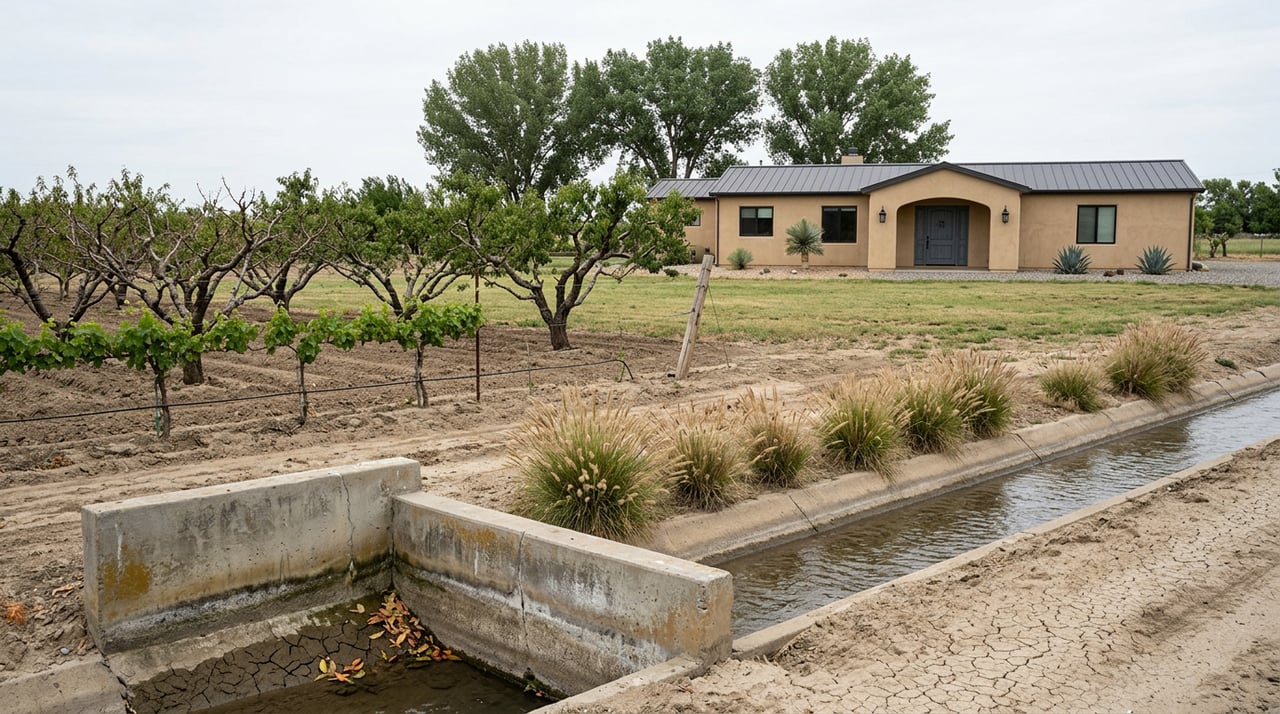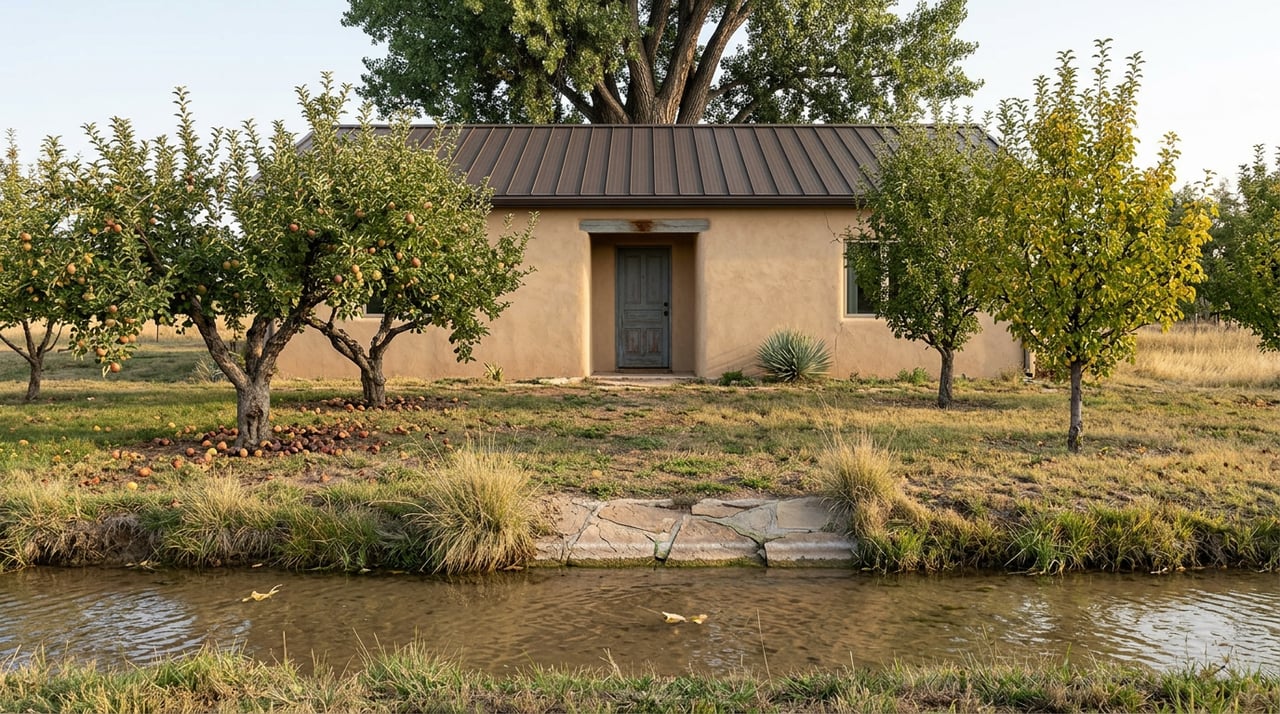
A Corrales listing this spring read the way these listings always do: mature fruit trees, ditch access, water rights through the Middle Rio Grande Conservancy District. What the listing didn't say was that the pumps behind that water right had been shut off since April 21, 2026, and would stay off for weeks while the Rio Grande ran too low to run them.
That gap between what a deed promises and what a ditch actually delivers is not a footnote for Corrales buyers this year. It is the whole story.
A water right and a delivery of water are two different things
New Mexico treats water as state property. Owning land next to a ditch or a stream does not mean you own the water in it. What you can own is a legal right to use a certain amount of water, established under a system where earlier claims outrank later ones. The Village of Corrales explains this plainly on its own water page: only water rights established for irrigation purposes are considered legally appurtenant to the land, meaning they transfer automatically in a sale even if the deed never mentions them. A right tied to a well, or a priority date that hasn't been actively used, doesn't move that cleanly. And under New Mexico's "use it or lose it" rule, a right that sits unused long enough can be forfeited outright.
None of that language tells a buyer whether the water will actually show up in a given irrigation season. That question got answered for Corrales in a very public way this year.
What the ditch actually did in 2026
The Middle Rio Grande Conservancy District suspended irrigation deliveries to the Corrales service area after river levels dropped below what the pump system needs to operate. The district's spokesperson put a number on it: river flow was about 430 cubic feet per second the day the pumps shut down, against a roughly 500 cubic feet per second threshold the pumps need to keep running. Mike Hamman, vice president of the Corrales Farmers' Cooperative, described the mood among growers as "not surprised, just disappointed."
By late May, the situation had escalated. The Village Council declared a drought state of emergency on May 26, 2026, citing New Mexico's own finding that roughly 94% of the state was under drought impact. Corrales residents on well backup kept gardens going. Those relying solely on ditch delivery did not have that option.
By mid-July, the conversation had moved from this year's dry spell to something more structural. Presenting the village's draft 40-year water plan to the Council on July 16, consultant Brittany Guame told councilors the region has lost a quarter of its water supply over the last two decades, with another quarter projected to disappear by 2050. Her framing of this year, reported by the Corrales Comment, was blunt:
"This is not a bad year, this is the new normal."
That is the sentence that should reframe how a buyer reads "irrigation rights included" on any Corrales listing going forward.
The siphon rebuild fixes infrastructure, not scarcity
The district is currently replacing the pump infrastructure that failed this spring, the Corrales Siphon, with completion expected by the end of 2026. That sounds like relief. It isn't quite that. Once the new siphon is running, Corrales moves into parity with other communities served by the district, which in practice is likely to mean everyone gets less water, not that Corrales gets more. The village's own water team is separately pursuing senior water rights purchases and a permit to pool existing rights, including two municipal wells and surface rights tied to the Gonzales property, into a single reservoir system, a process that, by the team's own estimate, takes a minimum of one to two years to complete and up to five years if anyone protests the transfer.
For a buyer, the takeaway isn't that Corrales is running out of water tomorrow. It's that the fix in progress addresses distribution and infrastructure, not the underlying supply problem the region is already living with.
What the deed promises versus what a buyer has to confirm
| Water source on a Corrales property | What the deed can promise | What only direct verification confirms |
|---|---|---|
| MRGCD ditch delivery, surface irrigation | An irrigation-purpose water right transfers automatically with a qualifying deed | Whether the pump system can physically deliver water this season, plus the ditch association's assessment and curtailment history |
| Private domestic or commercial well | An Office of the State Engineer-permitted well conveys with proper documentation | Tested yield, water quality, and whether drilling a new well would be read as waiving an older, more senior right already on file |
| Historic priority-date rights, including pre-1907 claims sometimes advertised on larger parcels | A recorded priority date establishes seniority in times of shortage | The right's current standing with the OSE, and whether extended non-use has put it at risk of forfeiture |
Village guidance is direct about the stakes underneath that last row: there is no hierarchy of "preferred" uses under New Mexico law, so a senior right for irrigation is treated the same as a senior right for drinking water. In a shortage, seniority is what protects continued use, not the stated purpose.
Questions to put in writing before you remove contingencies
- Request the recorded water right documentation, including priority date and type of right, and confirm its actual status directly with the Office of the State Engineer rather than relying on the seller's summary.
- Ask the servicing ditch or acequia association for bylaws, meeting minutes, and several years of delivery and curtailment history, not just a description of this year's suspension.
- Find out exactly how assessments are billed and whether unpaid amounts can attach to the property before closing.
- If a well serves the property, get the well completion report, a tested yield, and a current water quality test, and check whether the permit history shows any waived or lapsed rights.
- Ask the seller directly whether the property has been affected by an MRGCD delivery suspension in the past three years. The 2026 shutdown is public record. A vague answer here is itself information.
The disclosure form asks, but it doesn't verify
New Mexico doesn't have one single statutory law spelling out every seller disclosure duty. Instead, as Nolo's overview of the practice explains, the standard purchase agreement used across the state includes a seller's duty to disclose known adverse material facts, and the accompanying disclosure statement in wide use specifically asks sellers to address water rights and any membership in an irrigation or acequia association. That form puts the question on the table. It doesn't independently confirm the answer, and the Village of Corrales says as much on its own water page: verifying a water right's actual status with the state engineer is on the buyer, not something the deed or disclosure form settles by itself.
Because Corrales has no municipal water system at all, apart from a small stretch of Corrales Road served by a septic effluent pump system, this isn't a niche concern reserved for orchard and horse properties. Every home in the village depends on some combination of well and ditch infrastructure, and 2026 is the year that infrastructure visibly reached its limit.
FAQ
Does a water right automatically transfer when I buy a home in Corrales? Only if it was established for irrigation purposes. The village is explicit that this kind of right is considered legally appurtenant and transfers with a qualifying deed even if the paperwork doesn't spell it out. A well right or a standalone priority-date claim still needs direct confirmation with the Office of the State Engineer before you assume it's yours.
If MRGCD service gets suspended again, can I just switch to a well? Only if a properly permitted well already exists on the property. Village guidance warns that obtaining a brand-new well permit where an older water right is already on file can be treated as waiving that senior right, so the order of operations matters as much as having a well at all.
Is this really a concern for a smaller village lot, or just the big acreage listings? It applies broadly. Corrales has no municipal water system outside that small Corrales Road exception, so nearly every property in the village, regardless of lot size, is relying on some mix of well and ditch access that a buyer should verify directly rather than take on faith from a listing description.
Buying in Corrales still means buying into one of the more distinctive agricultural villages in the Rio Grande valley, and that character is worth protecting with real due diligence, not a checkbox on a form. If you're looking at a Corrales property and want a second set of eyes on the water rights question before you write an offer, Misty Strickland is glad to walk through it with you. Call or email for a personal market consult.